

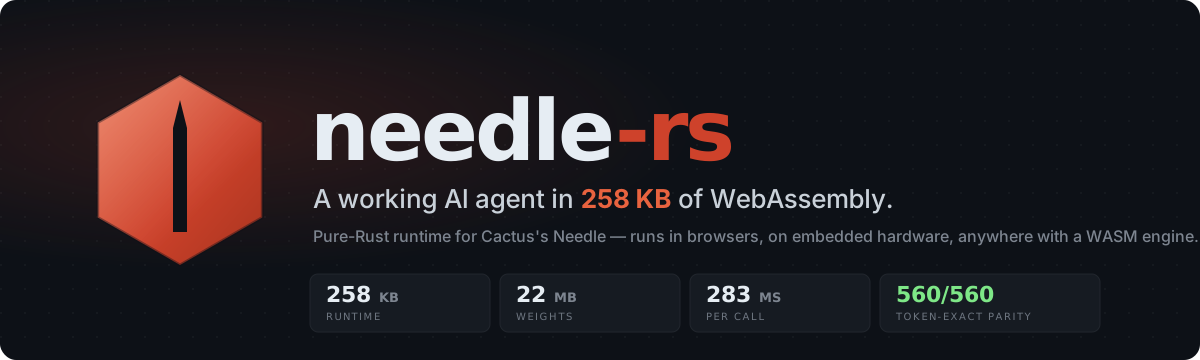




needle-rs-safetensors
INT4-packed SafeTensors weights for Needle, ready to load into the needle-rs pure-Rust + WebAssembly runtime.
This is a format conversion. The model itself — its architecture, training procedure, dataset, and original weights — is the work of Cactus Compute (Henry Ndubuaku et al., 2026), released under MIT. Original repository:
Cactus-Compute/needle.If you build with these weights, you are building on Cactus's Needle. Please credit them in any publication, blog post, product, or downstream model that incorporates this work. Citation template below.
Quick links
- Original model:
Cactus-Compute/needle— upstream weights, training code, paper - Runtime:
geekgineer/needle-rs— Rust, WASM, C ABI - Live demo: needle-rs.pages.dev — runs entirely in your browser
- Weight format spec: ARCHITECTURE.md
Files
| File | Size | Description |
|---|---|---|
needle.safetensors |
22 MB | INT4-packed attention/FFN weights + BF16 norms |
vocab.txt |
120 KB | 8,192 SentencePiece pieces (TSV: piece\tscore) |
banner.svg |
6 KB | Repo banner |
Model summary
| Architecture | Encoder–decoder transformer (SAN) |
| Parameters | 26M |
| Hidden size | 512 |
| Encoder / decoder layers | 12 / 8 |
| Attention heads (Q / KV) | 8 / 4 (GQA, repeat=2) |
| Vocabulary | 8,192 (SentencePiece BPE) |
| Max encoder length | 1,024 tokens |
| Quantization | INT4 group-wise (group_size=32) for attention + FFN; BF16 for norms/embeddings |
| Output | Structured JSON tool calls |
For full architectural details, training procedure, and benchmarks, see the upstream Needle repository.
Weight format
The SafeTensors file uses a custom I4 dtype for quantized kernels:
- Group-wise INT4 with
group_size=32, per-group scale =max|w| / 7, packed as nibbles (low nibble = even row, high nibble = odd row, per output column). - Non-kernel parameters (RMSNorm γ, gate vectors, embeddings) stored in BF16.
- Model config (d_model, num_heads, max_seq_len, etc.) embedded in the SafeTensors
__metadata__JSON, so no separate config file is needed.
This format is consumed directly by needle-rs. It is not compatible with transformers, safetensors-rust direct loading without the needle-rs engine, or other generic SafeTensors consumers, because the I4 dtype is non-standard.
How to use
The intended runtime is needle-rs. The same weights work across all its deployment targets — native CLI, Rust API, C FFI, and browser/Node.js via WebAssembly.
Download weights
from huggingface_hub import hf_hub_download

weights_path = hf_hub_download("Abdalrahman/needle-rs-safetensors", "needle.safetensors")
vocab_path   = hf_hub_download("Abdalrahman/needle-rs-safetensors", "vocab.txt")
Or via CLI:
huggingface-cli download Abdalrahman/needle-rs-safetensors \
  needle.safetensors vocab.txt --local-dir weights/
Command line
# Single inference
./needle-rs weights/needle.safetensors weights/vocab.txt \
  "What's the weather in Paris?" \
  '[{"name":"get_weather","parameters":{"type":"object","properties":{"location":{"type":"string"}}}}]'
# → {"name":"get_weather","arguments":{"location":"Paris"}}
Rust
use needle_infer::NeedleEngine;

let engine = NeedleEngine::load(
    "weights/needle.safetensors",
    "weights/vocab.txt",
)?;
let result = engine.run(query, tools_json);
println!("{}", result.text);
Browser (WebAssembly)
import init, { NeedleWasm } from "needle-rs";

await init();

const HF = "https://huggingface.co/Abdalrahman/needle-rs-safetensors/resolve/main";

const [weights, vocab] = await Promise.all([
  fetch(`${HF}/needle.safetensors`).then(r => r.arrayBuffer()).then(b => new Uint8Array(b)),
  fetch(`${HF}/vocab.txt`).then(r => r.text()),
]);

const engine = NeedleWasm.load(weights, vocab);
const result = engine.run("Book a flight from London to JFK tomorrow", toolsJson);
// → {"name":"book_flight","arguments":{"origin":"London","destination":"JFK","date":"tomorrow"}}
Live demo: needle-rs.pages.dev — the demo loads exactly these files from this repository.
Python
pip install needle-rs
from needle_rs import NeedleEngine

engine = NeedleEngine.load("weights/needle.safetensors", "weights/vocab.txt")

# Single call
result = engine.run(
    "Book a flight from London to JFK tomorrow",
    '[{"name":"book_flight","parameters":{"type":"object","properties":{"origin":{"type":"string"},"destination":{"type":"string"},"date":{"type":"string"}}}}]',
)
# → [{"name":"book_flight","arguments":{"origin":"London","destination":"JFK","date":"tomorrow"}}]

# Streaming (callback fires per token)
result = engine.run_stream(query, tools_json, lambda token_id, piece: print(piece, end="", flush=True))

# Batch
results = engine.run_batch([("query1", tools1), ("query2", tools2)])

# Semantic tool retrieval (requires weights with a contrastive head)
ranked = engine.retrieve_tools(
    "What's the weather in Paris?",
    ["Get current weather for a location", "Book a flight", "Send an email"],
    top_k=2,
)
# → [(0, 0.91), (1, 0.38)]
Multi-tool routing example
Needle is trained to pick the right tool from a list, not just fill a single tool's parameters:
./needle-rs weights/needle.safetensors weights/vocab.txt \
  "Turn off the bedroom lights" \
  '[
    {"name":"get_weather","parameters":{"type":"object","properties":{"location":{"type":"string"}}}},
    {"name":"play_music","parameters":{"type":"object","properties":{"song":{"type":"string"}}}},
    {"name":"control_lights","parameters":{"type":"object","properties":{"room":{"type":"string"},"state":{"type":"string"}}}},
    {"name":"send_message","parameters":{"type":"object","properties":{"recipient":{"type":"string"},"body":{"type":"string"}}}}
  ]'
# → {"name":"control_lights","arguments":{"room":"bedroom","state":"off"}}
Intended use
- Client-side intent routing in web applications — decide which API endpoint to call before issuing the network request, with no server-side LLM.
- Edge function dispatch — Cloudflare Workers, Vercel Edge, Deno Deploy, anywhere with a WASM engine and ≤30 MB of available memory.
- On-device function calling in privacy-sensitive contexts (healthcare, legal, personal data) where sending user queries to a hosted LLM is unacceptable.
- Embedded agents on hardware with enough RAM for the weights (≈30 MB working set including activations).
- Tool retrieval — the optional contrastive head exposed by
needle-rs.encode_contrastive()can semantically rank a tool catalogue before passing the top-K to the generator.
Limitations
- Tool calling only. Needle is trained for the single task of mapping a query plus tool definitions to a JSON call. It is not a chat model and will not produce meaningful free-form text.
- Single-shot. No multi-turn dialogue, no chain-of-thought, no tool-use feedback loop. Each call is independent.
- English-trained. Multilingual behavior is not evaluated by upstream and is not guaranteed.
- Greedy decoding only in
needle-rs— temperature and sampling are intentionally not supported, since stochasticity is undesirable for routing. - Encoder length ≤ 1,024 tokens. Long tool catalogues must be pre-filtered via contrastive retrieval before being passed in.
- Small-model failure modes apply. Ambiguous queries, tools with overlapping descriptions, or unusual parameter schemas can produce unexpected routings. The constrained decoder guarantees syntactic validity, not semantic correctness.
Out of scope
- General-purpose text generation, summarization, translation, or chat.
- Long-context reasoning (>1,024 tokens of input).
- Reasoning over tool outputs (the model produces calls, not results — your application executes the call and decides what to do with the response).
- Production use in safety-critical domains without an evaluation suite covering the specific tool catalogue and query distribution.
Citation
If you publish or distribute work that uses these weights, please cite the upstream Needle paper/repository:
@misc{ndubuaku2026needle,
  title  = {Needle: A 26M-Parameter Tool-Calling Transformer},
  author = {Ndubuaku, Henry and Mroz, Jakub and Mosoyan, Karen and Shemet, Roman
            and Sandhu, Parkirat and Kumar, Satyajit and Cylich, Noah and Lee, Justin H.},
  year   = {2026},
  url    = {https://github.com/cactus-compute/needle}
}
Optionally, cite the runtime if relevant to your work:
@misc{ibrahim2026needlers,
  title  = {needle-rs: Pure-Rust + WebAssembly Runtime for Needle},
  author = {Ibrahim, Abdalrahman},
  year   = {2026},
  url    = {https://github.com/geekgineer/needle-rs}
}
License
MIT — matching the upstream Needle release.
This repository performs only format conversion (Flax/Pickle → SafeTensors with INT4 packing) and quantization (BF16 → INT4 group-wise) of weights originally released by Cactus Compute under MIT. No retraining, fine-tuning, distillation, or modification of model behavior has been performed. All learned parameters originate from the upstream release.
Acknowledgments
The Needle model is the work of Henry Ndubuaku and the Cactus Compute team. Their decision to release the weights, training code, and dataset generation pipeline under MIT is what makes downstream runtimes like needle-rs possible. If this conversion is useful to you, please consider starring the upstream repository as well.
- Downloads last month
- 23
Model tree for Abdalrahman/needle-rs-safetensors
Base model
Cactus-Compute/needle